
Updated April 8, 2026
Quick answer
Most fix-and-flip lenders require 10-20% down on the purchase price, with rehab costs financed up to 100% — all subject to a total leverage cap of 70-75% of ARV. Experienced flippers with documented track records can push leverage higher and reduce capital outlay; first-time flippers usually contribute more equity, hold larger liquidity reserves, and need stronger ARV support. Plan for closing costs, appraisal, points, and an interest reserve on top of the down payment. True 100% financing is rare — lenders want skin in the game on every deal.
Typical Down Payment Range
For most structured fix and flip programs:
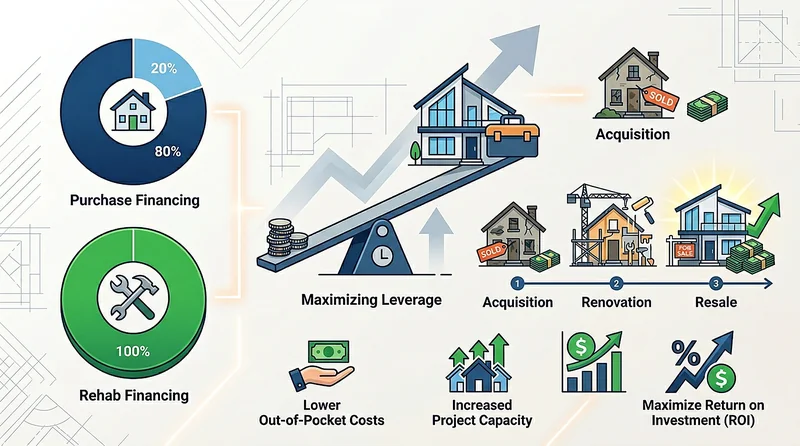
- Investors typically contribute 10%-20% of the purchase price
- Total leverage is often capped at 70%-75% of ARV
- Rehab costs may be financed up to 100% (subject to leverage caps)
- Down payment is tied directly to ARV-based underwriting
How Lenders Calculate Down Payment
Fix and flip loans are usually structured around Loan-to-After-Repair-Value (LTARV), Loan-to-Cost (LTC), and Loan-to-Value (LTV). Most lenders cap total loan exposure at approximately 70-75% of ARV.
Example Scenario
Purchase price: $200,000 | Rehab budget: $10,000 | Total project cost: $210,000 | ARV: $400,000
If the lender caps at 75% of ARV: 75% of $400,000 = $300,000 maximum loan. In this scenario, the investor may need minimal capital toward rehab but must still contribute closing costs and reserves. If ARV support is weaker or leverage caps are lower, required down payment increases.
Minimum Investor Contribution
When leverage is strong, lenders typically require investors to have skin in the game, closing costs covered, liquidity reserves, and contingency funds. Most lenders prefer investors to contribute at least some portion of acquisition cost. Highly leveraged deals with little investor equity are less common with structured capital providers.
Does Experience Affect Down Payment?
Yes. Experienced investors often qualify for higher leverage, lower required capital contribution, and better pricing. First-time flippers may need larger down payment, stronger ARV support, higher liquidity reserves, and stronger deal metrics. If evaluating eligibility, reviewing structured Fix and Flip loan programs can clarify leverage thresholds.
What About 100% Financing?
While some investors search for "no money down fix and flip loans," 100% acquisition financing without any capital contribution is rare. Rehab costs are sometimes financed at 100% with institutional lenders, but most structured programs require down payment based on purchase, closing cost coverage, and liquidity reserves.
How Credit Impacts Down Payment
Credit strength influences maximum leverage, pricing, points, and documentation requirements. Stronger credit may reduce required capital contribution. If credit is borderline, reviewing credit score requirements for fix and flip loans can help set realistic expectations.
Other Costs Investors Should Budget For
In addition to down payment: origination points, appraisal fees, inspection fees, title and closing costs, interest reserves (if required), and rehab contingency. Proper budgeting is critical for maintaining profitability.
What Determines Final Leverage?
- ARV Support: Is the after-repair value realistic and well-supported by comps?
- Purchase Discount: Is the property acquired at a meaningful discount?
- Rehab Scope: Is the renovation budget realistic and professionally estimated?
- Market Conditions: Is demand strong in the local market?
- Borrower Profile: Credit, liquidity, and experience all influence leverage. Strong deals may require less investor capital than weak deals.
How to Minimize Your Required Down Payment
Investors can reduce required capital by: negotiating stronger purchase discounts, providing accurate ARV comps, presenting detailed rehab plans, demonstrating prior successful flips, and maintaining strong liquidity. Leverage is ultimately driven by deal strength.
Final Thoughts
Most fix and flip loans require investors to contribute 10-20% of the purchase price, though exact requirements depend on ARV/leverage caps and borrower strength. While rehab funds are often financed, lenders still require investor equity and liquidity. The strongest leverage is typically reserved for experienced investors with solid credit and well-structured deals. If analyzing a potential acquisition, reviewing structured fix and flip loan options can clarify real capital requirements.
Frequently Asked Questions
How much down payment do you need for a fix and flip loan?
Typically 10–25% of the project, though it is really driven by the ARV cap — commonly 70–75% of after-repair value — and how much of purchase plus rehab the lender funds. Stronger deals, credit, and experience lower the cash you must bring.
Is 100% fix and flip financing possible?
Rarely, and usually only for experienced flippers on strong deals or by cross-collateralizing other property. Most investors should plan to contribute equity to fill the gap between the loan and total cost.
Does experience lower my fix and flip down payment?
Yes. A track record of completed flips earns higher leverage and a smaller required contribution, because the lender sees less execution risk. First-timers should expect to bring more cash.
How can I minimize my down payment on a flip?
Bring a defensible, comp-supported ARV, a tight rehab budget, solid credit, and any track record. Each reduces lender risk and lets them fund more of purchase plus rehab, lowering your cash in the deal.
Can you get 100% financing on a fix-and-flip?
True 100% financing is rare. Experienced flippers with track records can push leverage higher, but most contribute equity, hold liquidity reserves, and need strong ARV support.
What costs are there beyond the down payment?
Plan for closing costs, the appraisal, points, and an interest reserve on top of the down payment.