
Merchant Cash Advance Requirements: What You Need to Qualify

Card volume, bank deposits, time in business, and what MCA providers look for

Quick Answer: Typical MCA Requirements

Most MCA providers look for:

  • Card volume or bank deposits: often $5,000—$10,000+ per month (minimums vary)
  • Time in business: commonly 3—6+ months; some accept newer businesses
  • Bank statements: 3—6 months to verify deposits and behavior
  • Application and ID: completed application and owner ID
  • Credit: often secondary; many accept 500+ or lower when volume is strong
Typical requirements to qualify for an MCA

For what providers evaluate in detail, see what do lenders look for in a merchant cash advance. For amount, see how much you can qualify for with an MCA.

Merchant Cash Advance Requirements at a Glance

Requirement Typical Notes
Monthly volume/deposits$5K—$10K+Card or bank deposits
Time in business3—6+ monthsSome accept newer
Bank statements3—6 monthsAll pages, complete
CreditOften 500+Credit for MCA

1) Card Volume or Bank Deposits

The main requirement is verifiable revenue that can support the daily or weekly remittance. For card-based MCAs, providers look at monthly card sales; for ACH-based advances, they use bank deposit history. Minimums vary—often $5,000—$10,000 per month—and higher, consistent volume typically supports larger advances and sometimes better factor rates. For how amounts are calculated, see how much you can qualify for with a merchant cash advance.

2) Time in Business

Many providers want 3—6+ months of history so they can see consistency. Newer businesses may qualify with strong volume but might get smaller advances or shorter terms. Longer history can improve advance size and pricing.

3) Bank Statements

Providers use bank statements to verify deposits, check for overdrafts, and assess banking behavior. Provide 3—6 months, all pages, no gaps. Frequent overdrafts or declining deposits can reduce approval or amount. Clean statements help.

4) Credit (Often Secondary)

MCA underwriting emphasizes revenue and remittance capacity more than credit. Many providers accept 500+ FICO or lower when volume is strong. Credit can still affect factor rate or advance size. For details, see what credit score is needed for a merchant cash advance.

5) Application and ID

You’ll complete an application (business name, ownership, revenue, use of funds) and provide government-issued ID. Some providers request merchant processing statements if repayment is tied to card splits. For the process, see how to apply for a merchant cash advance.

Requirements by Industry

MCAs are common in retail, restaurants, and service businesses with strong card or deposit volume. Requirements can vary by industry because of seasonality or risk. See MCA for restaurants, MCA for retail stores, and MCA for auto repair shops for industry-specific context.

MCA vs Working Capital Loan: How Requirements Differ

Working capital loans often require stronger credit and more documentation (e.g. tax returns for larger amounts) but can offer lower cost and fixed payments. MCAs prioritize volume and speed with less emphasis on credit. Compare in merchant cash advance vs working capital loan. If you have strong credit and predictable cash flow, a working capital loan or line of credit may be cheaper long-term.

Red Flags and Traps

MCA cost is driven by factor rate and holdback; terms can be complex. Before you sign, understand total repayment, daily/weekly remittance, and what happens if you pay early. See red flags in MCA agreements and MCA mistakes that keep you in a cycle. Compare with revenue-based financing vs MCA if you want a different repayment structure.

Pre-Application Checklist

Before applying: (1) Confirm monthly card volume or deposits meet the provider’s minimum. (2) Gather 3—6 months of bank statements (all pages). (3) Have a clear use of funds. (4) Understand factor rate, holdback, and total repayment. (5) Check for existing MCAs or daily remittances that could limit capacity. (6) Compare providers for cost and terms so you avoid traps. For speed, see how fast you can get a merchant cash advance.

Common Reasons MCA Applications Are Declined

Declines often happen when: monthly volume or deposits are below the provider’s minimum, statements show frequent overdrafts or declining deposits, the business is too new with no track record, or there are already multiple advances or daily remittances that would overextend cash flow. Cleaning up bank statements, waiting for a few stronger months, or paying down existing advances can help. If you need lower-cost options, compare MCA vs working capital loan and RBF vs MCA.

Example: How Daily Remittance Affects Cash Flow

Suppose you take a $30,000 advance with a 1.25 factor rate (repay $37,500) and a 15% daily holdback from card sales. If you do $1,000 in card sales per day, $150 goes to the provider daily. At that rate you’d repay in about 250 days. If sales drop to $500/day, you still pay 15% ($75/day), which is a higher share of revenue and can strain operations. That’s why understanding holdback percentage and your lowest-volume periods matters before you sign. See red flags in MCA agreements and MCA mistakes that keep you in a cycle.

Bottom Line

Merchant cash advance requirements center on verifiable card volume or bank deposits, a few months in business, and bank statements. Credit is often secondary. Prepare complete statements and understand total cost and remittance before you commit. If you want to see which MCA providers fit your business, get matched.

Merchant Cash Advance: Remittance, Total Cost, and Cash-Flow Fit

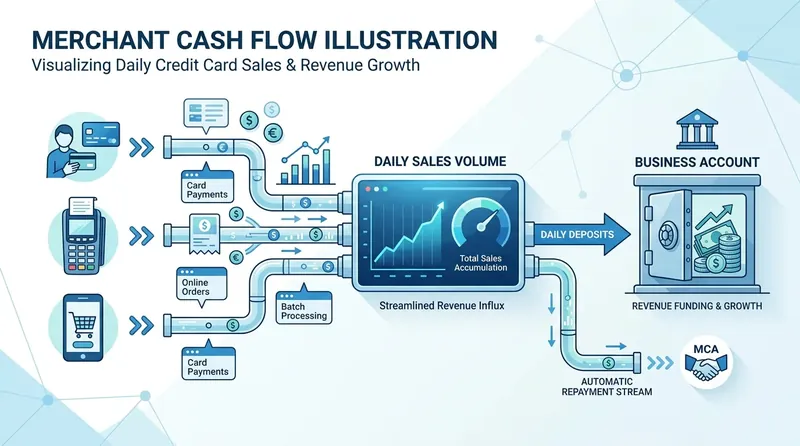
MCAs purchase future receivables and collect through agreed remittance—often daily or weekly. Total cost is not the same as APR; always translate offers into total dollars repaid and calendar debits relative to your deposit cycles. If remittance collides with payroll or vendor pulls, the advance can create stress even when sales look healthy.

Underwriters evaluate card volume trends, chargebacks, existing stacked positions, and bank behavior. Disclosure quality matters: undisclosed advances discovered in review slow funding and can reduce trust.

Application Discipline

  • Complete statements: sequential months with all pages.
  • Processor verification: timely access and accurate MIDs.
  • Stacking map: every active advance with payment amounts.
  • Use of funds: specific and tied to revenue timing.

Comparing Offers and Avoiding Harmful Structures

Compare factor or total payback, remittance frequency, fees, and any reconciliation clauses. Ask what happens if sales slow. If a deal feels rushed, pause—clarity beats speed when debits are frequent.

Alternatives may fit better when eligible: working capital loans, business lines of credit, or equipment financing for asset purchases.

Post-Funding Controls and Exit Planning

After funding, monitor balances and remittance against forecast weekly. If performance weakens, communicate early. If you plan payoff or refinance, request payoff letters and coordinate sequencing when multiple positions exist.

Businesses with a defined exit plan fare better than those that roll renewals indefinitely. Treat MCAs as a bridge, not a permanent operating baseline.

Governance, Documentation, and Long-Term Strategy

Assign one owner for funder communication and keep a stipulation log with due dates. Archive executed agreements and track effective remittance start dates. After three months, review whether total cost and cash impact match expectations—if not, adjust operations or pursue refinance with a complete file.

Get matched for options aligned to your profile. Use our calculator to model obligations.

Scenario Planning and Stress Testing

Build a simple monthly model with base and stress sales. In stress, reduce revenue 10–20% and check whether remittance still leaves room for payroll, rent, and taxes. If not, reduce the requested amount or choose a different product.

Document assumptions and revisit them monthly. Revolving and remittance-based products amplify operational variance—small changes in sales can swing liquidity quickly without proactive monitoring.

Typical Documentation Funders Request

Most MCA programs ask for recent business bank statements, card processing statements, a voided check or bank verification, and basic business identification. Time in business and monthly card volume are common thresholds, though exact standards vary by funder. Incomplete files—missing pages, gaps between months, or password-protected statements without access—are a frequent reason approvals stall.

Owners should expect identity and authorization checks. Signer verification, EIN confirmation, and sometimes landlord or lease documentation may be required for retail locations. If your business recently changed names, banks, or processors, keep a paper trail that connects old and new accounts so underwriters can follow deposit continuity.

Credit, Risk Signals, and Bank Behavior

While MCAs emphasize cash flow, many programs still review credit history and public records. Tax liens, judgments, or recent bankruptcies can affect approval or size. Bank behavior matters: negative ending balances, frequent NSF items, or erratic deposit timing can signal elevated risk. Cleaning up daily banking patterns before applying sometimes improves outcomes more than marginal credit score changes.

Chargebacks, fraud alerts, and high-ticket irregularities on the card side can trigger additional review. Maintain clear refund policies and reconcile deposits to sales to avoid unexplained variance.

Industry, Seasonality, and Disclosure

Some industries face additional scrutiny or restricted programs. Seasonal businesses may need to show year-over-year patterns rather than a single peak month. Full disclosure of existing advances—including balances and payment amounts—speeds underwriting and reduces surprises at verification. Attempting to hide active positions usually backfires when funders reconcile bank and processor data.

Underwriting Timelines and Exceptions

Same-day marketing is not the same as same-day funding for every file. Exceptions—large amounts, complex ownership, recent processor changes, or prior defaults—route to manual review. Providing a narrative memo that explains anomalies in statements reduces back-and-forth. For example, if one month shows a one-time asset sale deposit, label it so underwriters do not treat it as recurring revenue.

Guarantors and additional signers may need to complete verification steps. Delays often come from incomplete KYC packages rather than from the core business story.

Collateral, UCC, and Seniority

Some programs file UCC statements or take security interests in receivables. Understand seniority relative to other lenders and how payoffs release liens. If you refinance, coordinate UCC releases so the next funder has a clear first position where applicable.

Processor Health and Reserve Accounts

Processors occasionally place reserves or holdbacks after risk reviews. If your statements show rolling reserves, explain the reason and the expected release schedule. Funders want confidence that net card deposits available to service remittance match the story in your application.

Multi-Location and Franchise Considerations

Operators with several stores should clarify whether funding is entity-level or location-specific and how remittance maps to consolidated cash. Franchise agreements may impose restrictions on additional obligations—review those provisions before committing.

Renewal and Cross-Default Awareness

Existing agreements may include provisions affecting new obligations. Disclosure prevents accidental cross-defaults and keeps refinancing options open.

Bankruptcy, Restructuring, and Disclosure Standards

Prior business or personal bankruptcy does not automatically disqualify an application, but funders need accurate timelines, discharge status, and current operating performance. Omitting material history slows review when public records surface later. A concise narrative with dates and outcomes is more credible than silence.

Merchant Category Codes and Descriptor Alignment

Card descriptors should match your registered business name where possible. Mismatched descriptors increase chargebacks and customer confusion, which can elevate risk scores. Align branding across storefront, receipts, and online checkout.

Beneficial Ownership and Control Persons

Corporate transparency rules may require identification of individuals who own twenty-five percent or more and control persons even without large equity stakes. Have government-issued IDs and ownership charts ready to avoid identity verification delays.

Foreign Exchange and Multi-Currency Deposits

Businesses receiving foreign currency may need additional statements or conversion explanations. Map settlement timing to domestic bank posting so underwriters see a coherent flow.

Data Security and Sharing Permissions

Secure portals beat email for sensitive statements. When funders request read-only bank access, use official integrations and revoke access after closing if policy allows. Clear permissions reduce fraud holds triggered by unusual login patterns.

Closing Checklist and Funding Mechanics

After approval, confirm legal business name on documents, routing and account numbers for deposits, and authorized signers. Typos in wire instructions or ACH details cause preventable delays. Review remittance start dates and any proration around weekends or bank holidays.

Final readiness step: confirm email and phone on file match your bank and processor profiles so two-factor and verification codes route without delay.