
Updated June 11, 2026
Quick answer
Most MCA providers approve 1.0-1.5x your average monthly card sales or bank deposits, with absolute amounts running $5,000-$500,000 (typical range $25,000-$150,000). A business doing $50K/month in card volume usually qualifies for $50K-$100K, minus any outstanding advance balances. Providers want at least 6-12 months in business, clean bank statements, and stable or growing trends. Factor rates of 1.15-1.50 determine total repayment — a $50K advance at 1.30 means $65K back. Pay down existing MCAs before applying to free up capacity.
Typical MCA Advance Ranges
Most providers offer:
- Minimum: $5,000–$10,000
- Maximum: $250,000–$500,000 (varies by provider and profile)
- Typical range: $25,000–$150,000
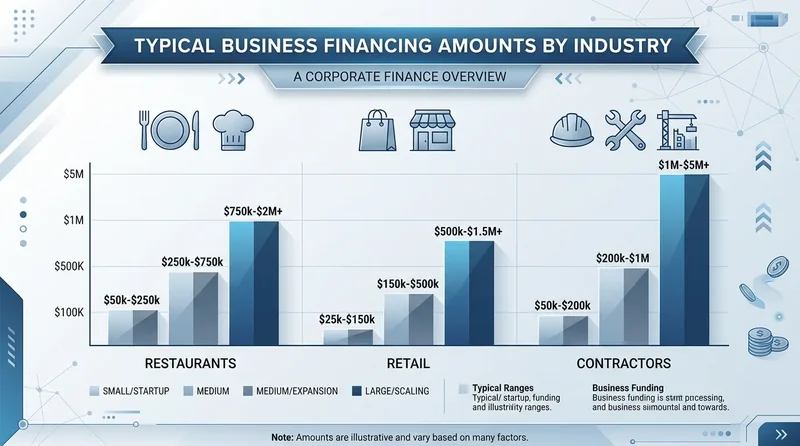
Higher advances require stronger card volume, stable deposits, and often a clean history with previous advances. Newer businesses or those with variable sales may see offers at the lower end of the range. Established businesses with consistent card volume and minimal existing advance exposure can often access amounts toward the upper end. See what lenders look for in a merchant cash advance for the full underwriting picture.
How Providers Calculate Your Cap
Most MCA providers use a multiple of your average monthly card sales or bank deposits. A common approach is to cap your advance at 1.0 to 2.0 times your average monthly volume, depending on your profile. For example, if your average monthly card sales are $50,000, you might qualify for $50,000 to $100,000, before adjusting for existing obligations or risk factors. Providers then subtract any outstanding MCA balances and apply a factor rate to determine your total repayment. The holdback percentage is set so that, at your expected sales volume, the obligation is repaid within a typical timeframe (often 3–12 months).
What Drives Your MCA Amount
Monthly Card Sales Volume
Card volume is the primary driver. Providers often cap advances at 1–2— your average monthly card sales. Example: $40,000/month in card sales might support a $40,000–$80,000 advance, depending on provider and other factors.
Bank Deposits (ACH Programs)
Some providers use bank deposits instead of or in addition to card sales. They may offer 1–1.5— average monthly deposits. Diversified deposits (card plus other revenue) can support higher amounts.
Time in Business
Providers prefer 6–12+ months of operating history with consistent sales. Newer businesses may qualify for smaller advances or higher factor rates.
Existing MCA or Advance Balances
Outstanding advances reduce available capacity. Many providers limit total exposure (your advance plus any other open MCAs) as a multiple of monthly sales. See what lenders look for in a merchant cash advance for underwriting details.
Factor Rates and Total Repayment
Amount received is one side; total cost is the other. Factor rates typically range from 1.15 to 1.50. Example: $50,000 advance at 1.30 factor means you repay $65,000 total. Higher-risk profiles often see higher factor rates; stronger profiles may get lower rates and larger amounts.
Estimating Your Advance
Rough guideline: expect 1–1.5— monthly card sales or deposits, adjusted down if you have existing MCA balances or weaker metrics. Actual offers vary by provider and your full profile. To refine your estimate, pull your last 3–6 months of card volume and bank deposits, calculate the average, and multiply by 1.0 to 1.5. Subtract any outstanding MCA or advance balances. The result is a ballpark of what you might qualify for. Providers may offer more or less based on trends (growing vs. declining), industry, and their own risk appetites.
Example Scenarios
Scenario A: Restaurant with $60,000 average monthly card sales, 18 months in business, no existing advances. Likely range: $60,000–$90,000 or more, depending on factor rate and holdback.
Scenario B: Retail store with $25,000 monthly card sales and an outstanding $15,000 MCA. Available capacity is reduced; a new advance might cap at $10,000–$25,000 after accounting for the existing obligation.
Scenario C: Salon with $12,000 monthly card sales, 8 months in business. May qualify for $10,000–$18,000; newer businesses often receive smaller advances or higher factor rates until they build more history.
Increasing Your MCA Amount
- Build consistent card volume for 6+ months: Providers prefer stable or growing trends. A steady $40,000/month for six months is stronger than $60,000 one month and $20,000 the next.
- Reduce or pay off existing advances before applying: Each open advance reduces your available capacity. Paying down or paying off existing MCAs frees room for a new, potentially larger advance.
- Keep bank statements clean: Few NSF or overdrafts, consistent deposits, and a healthy average balance improve your profile and may support larger offers.
- Provide complete, accurate documentation: Discrepancies between your application and bank/processor data can trigger smaller offers or denials. Ensure numbers match.
- Apply when you are in a strong month: If you are seasonal, apply during or right after a strong period so your recent data reflects your best performance.
Alternatives for Higher Amounts
If you need more than MCA typically offers, consider revenue-based financing, which often bases amounts on monthly revenue and can support larger advances for businesses with strong top-line sales. Working capital loans provide fixed-term financing with predictable monthly payments. For larger, longer-term needs, term loans or SBA loans may be a better fit. Compare RBF vs MCA if you have strong monthly revenue but less daily card volume. You can also combine products: use MCA for immediate needs and a term loan for larger, structured capital.
When to Take Less Than You Qualify For
Sometimes you may qualify for more than you need. Taking a smaller advance can reduce total cost (lower factor-rate dollar amount), shorten the repayment period, and leave capacity for future needs. It also reduces the daily holdback, which helps cash flow. Only borrow what you need for a defined purpose; avoid taking the maximum just because it is offered.
Final Thoughts
MCA amounts are driven by card volume, bank deposits, and existing advance exposure. Plan for 1–1.5— monthly sales as a rule of thumb, then refine based on your provider’s offer. Review merchant cash advance options and credit score requirements to align expectations before applying.
Sizing Logic: Revenue, Remittance, and Stacking Constraints
MCA offers are typically constrained by a share of historical card sales and a stress test on whether debits leave enough room for operations. If you already have daily or weekly remittances, new advances stack on top—underwriters evaluate total burden, not only the new offer in isolation.
Seasonal businesses should provide enough history to show both peak and trough months. A single strong month can inflate expectations; twelve months of data usually produces safer sizing.
Illustrative Comparison Framework (Not a Guarantee)
| Factor | Effect on limit |
|---|---|
| Higher stable card volume | Often supports larger offers |
| Existing daily remittances | Often reduces safe headroom |
| Chargebacks or refunds | Can reduce perceived net sales |
| Thin or volatile deposits | Often lowers approval or increases cost |
Safe Sizing Questions to Ask Internally
- What is our weekly cash after payroll, rent, and taxes?
- What remittance amount fits our slowest sales weeks?
- What is our exit plan if sales dip 10–20%?
Sources & Further Reading
- CFPB Small Business Lending Research — CFPB research and rulemaking on small business credit, including how cost is disclosed to borrowers.
- Federal Reserve Small Business Credit Survey — Survey data on how small firms apply for and receive credit: approval rates, funding speed and reasons for denial.
- FTC: Protecting Small Businesses Seeking Financing — The FTC's guidance to lenders, brokers and merchant cash advance providers on misrepresented costs, unlawful collection and false claims of government affiliation.
Rate, fee, and policy figures cited above reflect current published guidance as of the article publication date. Always confirm current figures with the cited source or your lender before acting on financing decisions.
Frequently Asked Questions
How much can you qualify for with a merchant cash advance?
Most providers approve 1.0-1.5x your average monthly card sales or bank deposits, with amounts running $5,000-$500,000 (typical $25,000-$150,000), minus any outstanding advance balances.
How do MCA providers calculate your cap?
They base it on average monthly card volume or bank deposits. A business doing $50K per month in card volume usually qualifies for $50K-$100K.
What do MCA providers require to qualify?
At least 6-12 months in business, clean bank statements, and stable or growing revenue trends.
How do factor rates affect total MCA repayment?
Factor rates of 1.15-1.50 determine total repayment. A $50,000 advance at 1.30 means $65,000 paid back.