
Financing program
Negotiating balances down when the business genuinely cannot repay in full — and an honest account of what it costs you to do it.
Quick answer
Business debt settlement is a negotiated reduction of what you owe: the creditor accepts less than the full balance, generally because the alternative is default and a costly collection process. It is the route for a business that genuinely cannot repay in full. It carries real costs, and consolidation or restructuring is usually the better option where revenue is still intact.
Business debt settlement is a negotiated reduction of what a company owes: instead of repaying the full balance, the creditor accepts a lesser amount, usually because the alternative is default and a costly collection process with an uncertain recovery.
These three words get used loosely and they describe really different transactions with different consequences:
| Settlement | Restructuring | Consolidation | |
|---|---|---|---|
| Balance owed | Reduced | Unchanged | Paid in full by a new loan |
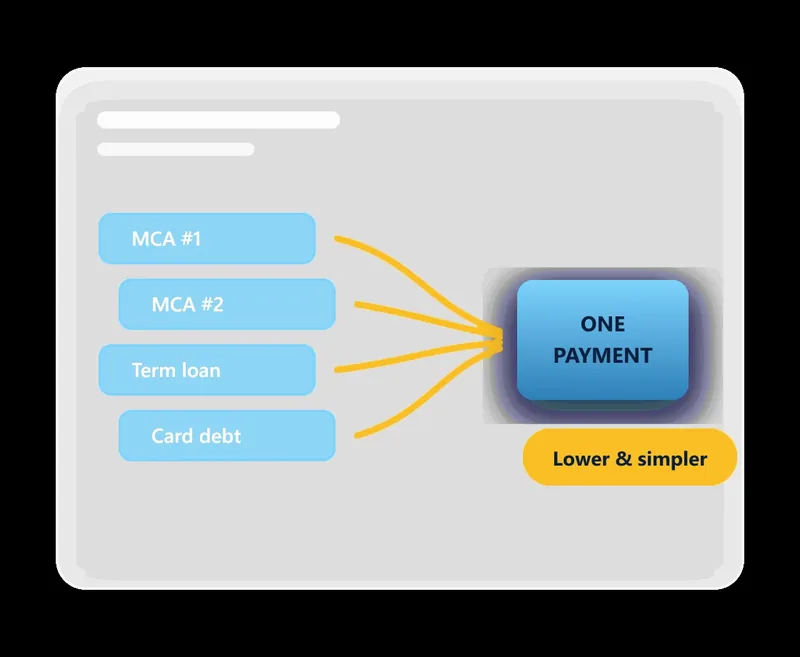
| Terms | Ends the obligation | Stretched or lowered | Replaced with one payment |
| New borrowing | None | None | Yes |
| Credit impact | Significant | Moderate | Least |
| Needs creditor consent | Yes | Yes | No |
Wondering if settlement is even the right route? If consolidation is available to you we'll say so, because it costs you far less.
Get a Free ReviewSettlement is the only one that reduces what you owe, and it is also the one with the largest consequences. If you can service a single consolidated payment on current revenue, consolidation is almost always the better outcome. Settlement is what remains when you can't.
That last point is the mechanism. A creditor settles because a reduced certain recovery beats a full uncertain one. If your business is visibly able to pay, there is no reason for anyone to accept less, and no amount of negotiation changes that.
Restructuring keeps the full balance but changes how it's paid: converting a daily debit to weekly or monthly, extending the term, pausing payments for a defined period, or re-sequencing which creditors are paid first. It carries less credit damage than settlement and is easier for a creditor to approve, because they still expect the full amount.
For merchant cash advances specifically, restructuring often begins with a reconciliation request instead of a negotiation. If your contract has a reconciliation clause and your revenue has fallen, an adjustment may already be contractually owed to you — see how to request an MCA reconciliation.
Be wary of any firm that guarantees a reduction percentage before reviewing your file, charges substantial fees up front, or instructs you to cut off contact with creditors. Those are the recurring hallmarks of the operators that give this category its reputation.
Step five is where self-managed settlements most often go wrong. A verbal agreement and a wire isn't a resolution; the filing has to come off and the release has to be in writing.
If you're still deciding between approaches, work through them in order of cost to you: consolidation first, then MCA-specific relief if advances are the core problem, then settlement, then mediation or bankruptcy. Skipping to settlement when consolidation was available costs you credit standing you did not need to spend.
Settlement isn't persuasion. A creditor accepts less when the arithmetic says a reduced certain recovery beats a full uncertain one. What moves that calculation:
Which is why the honest framing is that outcomes vary widely by creditor and by file, and anyone quoting you a percentage before reviewing yours is guessing.
Not all business debt behaves the same way in a negotiation.
| Debt type | Typically negotiable? | What complicates it |
|---|---|---|
| Merchant cash advances | Often | Confessions of judgment; some funders litigate by policy |
| Unsecured short-term loans | Often | Personal guarantees are near-universal |
| Equipment finance | Rarely | The lender can simply repossess the collateral |
| Commercial mortgages | Rarely | Secured by property with clear recovery value |
| Trade and vendor debt | Sometimes | You may need the supplier relationship to continue |
| SBA loans | Complex | Federal process, personal guarantees, agency rules |
The practical consequence is that a business with a mix most of the time can't pursue one strategy across all of it. Secured creditors get handled differently from unsecured ones, and the sequencing matters.
Negotiations run on documentation, not narrative. Before anyone contacts a creditor:
That last item drives everything downstream. Overstate it and you default on the settlement you just negotiated; understate it and you give away credibility. Send us the schedule and we will pressure-test the number with you.
The part that goes wrong most often is the paperwork, not the negotiation.
A first conversation costs nothing and doesn't commit you to a settlement strategy:
Business debt settlement is a negotiated reduction of what a company owes. Rather than repaying the full balance, the creditor agrees to accept less, generally because the alternative is default and a collection process with an uncertain recovery. It applies to business obligations including merchant cash advances, short-term loans, and trade debt.
Settlement reduces the balance owed and requires each creditor to agree. Consolidation doesn't reduce anything; it replaces multiple debts with a single new loan that pays them off in full, and doesn't require creditor consent. Consolidation carries far less credit damage, so it is the better route whenever the business can service the consolidated payment.
Usually yes. Paying less than the agreed amount is reported where the creditor reports, and the process often involves missed payments beforehand. If you signed a personal guarantee, the effect can reach your personal credit as well. Settlement is generally still less damaging than an unaddressed default and judgment.
Not automatically. A personal guarantee is a separate promise and can survive a settlement of the business obligation. Releasing it has to be negotiated explicitly and stated in the written settlement agreement. This is one of the most common and most expensive oversights in self-managed settlements.
Often, yes, though MCA funders vary widely in willingness and some litigate as a matter of policy. What makes settlement realistic is documented revenue decline and a credible alternative for the funder to weigh. We cover the specifics in our guide to settling a merchant cash advance.
It can be. Cancelled or forgiven debt is frequently treated as income for tax purposes, and the amount reduced in a settlement may be reportable. The treatment depends on your entity type and circumstances, so confirm with your accountant before agreeing to a settlement, not after.
It runs on the creditors' timelines, not yours. A single creditor might resolve in weeks; several positions commonly take months. Negotiations also stall and restart, particularly where a creditor has begun legal action. Anyone promising a fixed short timeline before reviewing your file is guessing.
It varies too widely by creditor, debt type, and circumstances for a meaningful average to be useful, and any firm quoting a percentage before reviewing your file is guessing. What determines it's your demonstrable inability to pay in full, what recovery would cost that creditor, whether the debt is secured, and whether a personal guarantee gives them a second target.
Not necessarily, and treating it as a required tactic is dangerous. Missed payments can accelerate the full balance, trigger a confession of judgment where one exists, and lead to a frozen bank account. Some creditors will not engage while you're current; others will. Stopping payments should be a deliberate decision with the consequences understood, not a default strategy.
Yes, and for a single creditor it's often sensible. It gets harder across several positions, where sequencing matters, where a confession of judgment or personal guarantee is involved, or where a creditor has begun legal action. The most common self-managed failure isn't the negotiation but the paperwork afterwards: no written release, no UCC termination, guarantee left unaddressed.
No. Settlement is a private negotiation with individual creditors and leaves the business operating. Bankruptcy is a court process that either discharges or reorganises debt under legal protection and binds all creditors. Settlement is generally attempted first because it is faster, cheaper, and less damaging, but it only works where creditors agree, and bankruptcy doesn't require their agreement.
Most of the time yes, at least for a period. A settled account signals to future lenders that you paid less than agreed, and where a personal guarantee was involved the effect can reach your personal credit too. It's generally less damaging than an unresolved default and judgment, which is the realistic alternative in most cases where settlement is on the table.
Tell us what you owe, to whom, and where you stand on payments. Axiant reviews the whole picture and tells you which route fits — including when the honest answer is that none of them do. One conversation, no obligation, and checking won't affect your credit.