
Updated June 3, 2026
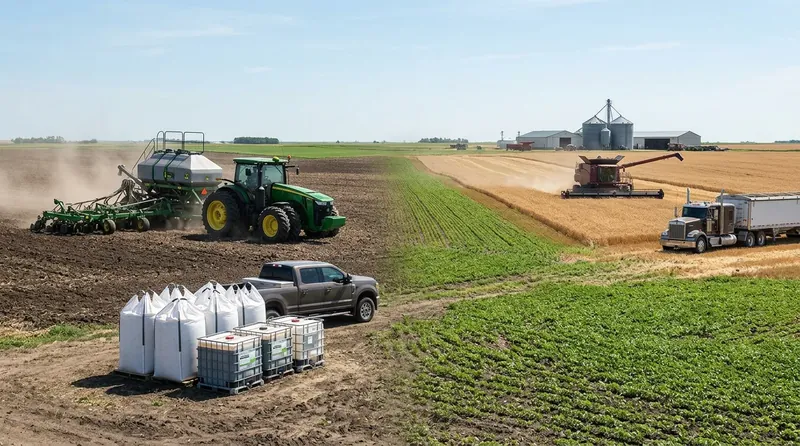
Why Farm Cash Flow Is Front-Loaded
No business has a longer gap between spending and earning than a row-crop farm. In the spring you commit to nearly the entire year’s production cost at once: seed goes in the ground, fertilizer and chemicals are applied, fuel runs the equipment, and custom operations and labor get paid. Then comes a long growing season with continued costs and no revenue at all, until the crop is harvested and sold in the fall. For livestock and other operations the calendar differs, but the principle is the same — feed, inputs, and care are paid continuously while income arrives in concentrated bursts at sale.
This is why operating credit isn’t a sign of a struggling farm; it’s the normal financial plumbing of agriculture. A farm can be profitable across the full year and still need to fund six-plus months of inputs before a single bushel is sold. The job of seasonal input financing is to carry that gap so the operation can plant the acreage it intends to, buy inputs at the right time, and wait for harvest without starving for cash in between.
The Operating Line Is the Backbone
For the recurring annual cycle, a revolving operating line of credit is the natural and traditional tool. You size it to a season’s input and operating budget, draw against it as costs hit through planting and the growing season, pay interest only on the outstanding balance, and pay it down after harvest when the crop or livestock is sold. Then the line resets, ready for next spring. Because the structure mirrors the farm’s own cash cycle so precisely, it’s the cleanest match for input financing — you’re never carrying more debt than the season actually requires at any moment.
A working capital loan fits differently — a lump sum with a set repayment schedule that suits a defined, one-time need rather than the open, revolving demand of a full season. Many farms also use supplier and co-op input programs for part of the bill; those can be convenient but are usually limited in size and tied to specific vendors, so an operating line remains the flexible core that covers everything and every supplier.
Input Price Volatility Raises the Stakes
What makes input financing more important than ever is how much the cost side swings. Fertilizer, fuel, and chemical prices have moved sharply in recent years, and a jump in any of them can add meaningfully to the per-acre cost a farm commits to before it knows what the crop will sell for. That volatility cuts two ways for cash planning: it raises the dollar amount you need to fund at planting, and it rewards the ability to buy inputs at the right moment rather than when cash happens to be available. A well-sized operating line gives a farm the flexibility to lock in inputs when pricing is favorable instead of being forced to buy late at a worse number simply because the money wasn’t there earlier.
A Worked Input-Cycle Example
Put rough numbers to a season. Suppose a farm plants 800 acres at an all-in input cost — seed, fertilizer, chemicals, fuel, and custom work — of around $400 per acre. That’s roughly $320,000 committed largely between spring planting and mid-season, with essentially no revenue until the crop comes off in the fall. Few operations want to pull $320,000 from cash reserves and sit exposed through the growing season, especially with land rent and equipment payments also due.
An operating line sized to that budget lets the farm draw as each cost arrives: a large draw for seed and fertilizer at planting, smaller draws for fuel and chemicals through the season. Interest accrues only on what’s drawn and outstanding, not the full limit. When the crop is sold — say it brings $520,000 — the farm repays the drawn balance plus interest and keeps the margin, and the line is clear for next spring. The figures are illustrative, not a quote, but they show the elegance of matching a revolving line to the crop cycle: the borrowing rises and falls with the season, and harvest itself retires the debt.
What Strengthens a Farm Financing File
Lenders financing agricultural operations look beyond a single number. A clear crop or livestock plan, the operation’s production history, and the borrower’s overall financial strength all matter. Risk mitigants carry real weight: crop insurance protects against a yield disaster, and forward contracts or marketing plans give some certainty to the revenue side, both of which make a lender more comfortable extending an operating line at a workable size and rate. Clean, separated books and records that distinguish farm from household finances help too. If you also need to fund machinery, keep that on its own track — see financing farm equipment — so the cost of long-lived iron doesn’t compete with the operating line that funds the crop.
Co-ops, Prepay Discounts, and the Operating Line
Many farms don’t buy inputs purely on cash or credit — they work through co-ops and dealers that offer prepay programs, early-order discounts, and their own financing on seed, fertilizer, and chemicals. These can be genuinely valuable: locking in a fertilizer price in the fall or prepaying for an early-order discount can save real money per acre. The catch is that prepay requires cash even earlier in the cycle — you’re funding next spring’s inputs months ahead of harvest revenue, widening the very gap this article is about.
This is where the operating line and supplier programs work together rather than competing. A well-sized line of credit gives you the flexibility to capture a prepay or early-order discount when the math favors it — drawing to lock in the lower price, then repaying after harvest — instead of passing on the savings because the cash wasn’t available that early. The discipline is to compare the discount against the short-term cost of the draw: if a fall prepay saves more per ton than the interest to carry it until harvest, financing the prepay is a net gain. Run that comparison deliberately rather than defaulting to “pay when cash shows up,” and the operating line becomes a tool for buying inputs at the best price, not just the affordable one.
Keep co-op balances and the operating line visible to each other, too. Stacking large dealer balances on top of a fully drawn line without a clear repayment path is how input costs quietly outrun a season’s revenue. Mapping all input obligations — co-op, prepay, and line draws — against expected harvest income keeps the whole input budget inside what the crop can repay.
Bottom Line
Farming front-loads a whole season’s inputs against revenue that doesn’t arrive until harvest, so operating credit is simply how the business works. Size an operating line of credit to your input budget, draw as costs hit and repay from harvest, use crop insurance and forward contracts to strengthen the file, and keep equipment financing separate. Start at the agriculture business financing hub, then get matched to compare options for your operation.
Frequently Asked Questions
How do farmers pay for seed and fertilizer before harvest?
Most use an operating line of credit drawn at planting to pay for seed, fertilizer, chemicals, and fuel, then repay after harvest when crops or livestock are sold. Supplier and co-op credit programs and working capital loans are also common.
What is a farm operating line of credit?
An operating line is revolving capital sized to a season's input and operating costs. You draw as expenses hit through planting and the growing season and repay from harvest revenue, so the line resets for the next year. It matches the farm's annual cash cycle.
Why are farm input costs so hard to cash-flow?
Inputs are front-loaded: seed, fertilizer, chemicals, and fuel are bought in spring, but crop revenue doesn't arrive until fall harvest and livestock revenue follows its own cycle. That leaves months of large outflows before any income, which is why operating credit is standard in farming.
Can newer or smaller farms get input financing?
Often yes. Lenders look at the operation's history, the crop or livestock plan, and the strength of the borrower. Crop insurance, forward contracts, and clean records all strengthen the file and can improve the limit and terms.
Still deciding? Tell us about your business and compare real options. Free, no obligation, and checking won't affect your credit.