
Updated June 3, 2026
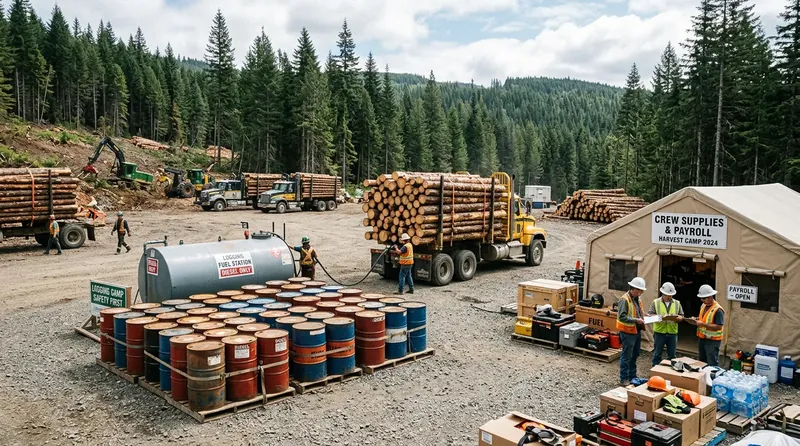
A Weekly Burn Against a Mill’s Schedule
Logging may have the harshest cost-timing of any trade. The weekly burn is enormous and non-negotiable: diesel for the machines and trucks, parts and repairs on equipment that takes a beating in the woods, tires and tracks, and a crew that has to be paid on schedule. None of it waits. On the other side, you don’t get paid when you cut the wood — you get paid when the mill settles for delivered loads, on its own terms, which can run a week, two weeks, or more after the wood crosses the scale. So money pours out continuously and comes back in lumps, weeks later.
That structure means a logging operation can be fully booked, cutting hard, and profitable on paper while still running dangerously short of cash mid-month. It isn’t a sign of a failing business; it’s the built-in timing of selling to mills. The job of working capital here is to carry the gap between the weekly burn and the mill check so the crew never stops for lack of fuel or a missed payroll.
Quotas and Price Swings Sharpen the Gap
Two industry realities deepen the problem. The first is mill quotas: mills frequently cap how much wood they’ll accept in a given week or period. When you’re put on quota, your deliveries — and therefore your revenue — are throttled even though your crew, equipment payments, and overhead are sized to cut more. Your costs don’t drop to match the quota, so the gap widens. The second is price and demand swings: stumpage and delivered prices move, and a soft market can shrink the revenue per load while your costs hold. Both can turn a normal timing gap into a real squeeze, and both are exactly what a flexible line of credit is meant to absorb — letting you keep the crew intact and ready when quotas open back up or prices recover.
Line of Credit vs. Factoring for Loggers
A business line of credit is the flexible everyday tool: draw for fuel, parts, and payroll as the week demands, pay interest only on what you use, and pay down as mill settlements land. Because the burn is constant and partly unpredictable (a blown hydraulic line doesn’t schedule itself), a revolving line fits the rhythm of the work. Invoice factoring attacks the receivable side directly: once you deliver loads and invoice a creditworthy mill, the factor advances most of that invoice within a day or two, then remits the rest minus a fee when the mill pays. That converts net-term mill receivables into immediate cash and scales automatically with your hauling volume, which suits operations where mill payments are the main thing standing between work done and cash in hand. Many loggers use a line for general flexibility and factoring when settlements stretch out.
A Worked Mill-Payment Gap
Put numbers to a typical month. Say the crew’s weekly burn — fuel, parts, and payroll — runs about $35,000, so roughly $140,000 a month goes out the door continuously. The mill settles delivered loads on terms that leave you waiting around two weeks per batch. At any given moment you might have $60,000–$80,000 of delivered-but-unpaid wood sitting in the mill’s payment pipeline while this week’s fuel and Friday’s payroll are due now.
A line sized to that carrying balance lets you draw to make payroll and keep the tanks full, then pay down when the settlements hit — smoothing the saw-tooth of the burn against the lumpy checks. Alternatively, factoring those mill invoices means you collect most of each $60,000–$80,000 batch within a couple of days of delivery instead of waiting two weeks, so your cash tracks your production. Either way, the crew never idles for a cash-timing reason. The figures are illustrative, not a quote, but they show why working capital is as essential to a logging operation as the skidder itself.
What Lenders Look For
For working-capital and factoring needs, lenders and factors look at the operation’s production history, the strength and creditworthiness of the mills you sell to, and your records. Steady delivery to established mills, hauling or cutting contracts, and clean books that separate the business’s finances all strengthen the file. Factoring in particular leans on the mill’s credit, so a newer logging company with solid mill relationships can often qualify even while its own balance sheet matures. Keep this working capital separate from the financing on your logging equipment so the two don’t compete. If credit is rebuilding, see business loans for bad credit.
Manage Mill Concentration and Relationships
Cash-flow risk in logging isn’t only about timing — it’s also about who you depend on to get paid. An operation that sells nearly all its wood to a single mill is exposed in a way that compounds the normal settlement gap: if that mill puts you on quota, slows its payments, changes prices, or has its own disruption, your entire revenue stream is affected at once. Cultivating relationships with more than one mill, where geography and product allow, spreads that risk and gives you somewhere to deliver when one mill tightens. It also strengthens your hand on terms, and it reassures a lender or factor that your receivables aren’t all riding on one buyer.
Where you do concentrate, the quality of the relationship matters. Established, consistent delivery to a reputable mill — ideally under a hauling or supply agreement — makes your receivables more predictable and more financeable, since factoring in particular depends on the mill’s creditworthiness and reliability as a payer. Keeping clean records of loads delivered, scale tickets, and settlements not only speeds your own reconciliation but also supports a stronger financing file, because it lets a lender see the real cadence of your production and payments.
Put together, the playbook is straightforward: use a line or factoring to bridge the inherent settlement gap, but reduce the underlying risk by diversifying mills where you can and documenting strong, consistent relationships where you concentrate. That combination keeps both your cash flow and your financing on solid ground through quota swings and market shifts.
Bottom Line
Logging spends every week and gets paid on the mill’s schedule, and quotas and price swings only widen the gap. A line of credit covers the fuel-parts-payroll burn and repays at settlement, while invoice factoring turns delivered-wood invoices into immediate cash — either keeps the crew running between checks. Match the tool to your settlement timing, lean on strong mill relationships, and keep equipment financing separate. Start at the forestry business financing hub, then get matched.
Frequently Asked Questions
Why do loggers have cash-flow problems even when busy?
Logging burns huge weekly costs, fuel, parts, tires/tracks, and crew payroll, while mills pay on quotas and net terms, often weeks after the wood is delivered. The cash leaves continuously and comes back in lumps, so a busy operation can still run short between settlements.
How do logging operations cover fuel and payroll between mill payments?
Many use a business line of credit drawn for fuel, parts, and payroll and repaid as mill settlements arrive. Invoice factoring can advance most of a delivered-wood invoice within a day or two, turning net-term mill receivables into near-immediate cash.
What are mill quotas and how do they affect cash flow?
Mills often cap how much wood they'll take in a period (a quota). When you're on quota, deliveries and therefore revenue are limited even if you can cut more, while your fixed costs continue, which can open a cash gap that financing helps bridge.
Is invoice factoring a good fit for logging?
It can be, because it advances cash against delivered-wood invoices to creditworthy mills and scales with your hauling volume. It turns net-term mill payments into immediate cash for fuel and payroll, which are the costs that can't wait.
Still deciding? Tell us about your business and compare real options. Free, no obligation, and checking won't affect your credit.