 Up to 17,657 ft³/h
Diamant 2000
Up to 795 hp4 ft 0 in × 3 ft 3 in feed openingintegrated crane, 32 ft 10 in reach at 2,205 lb


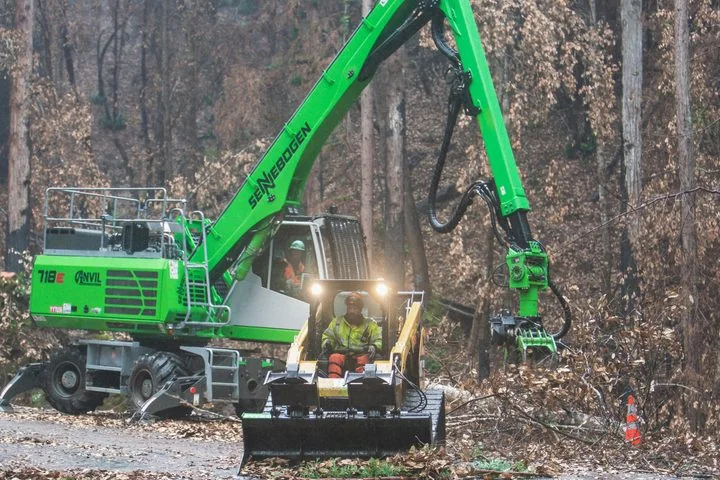
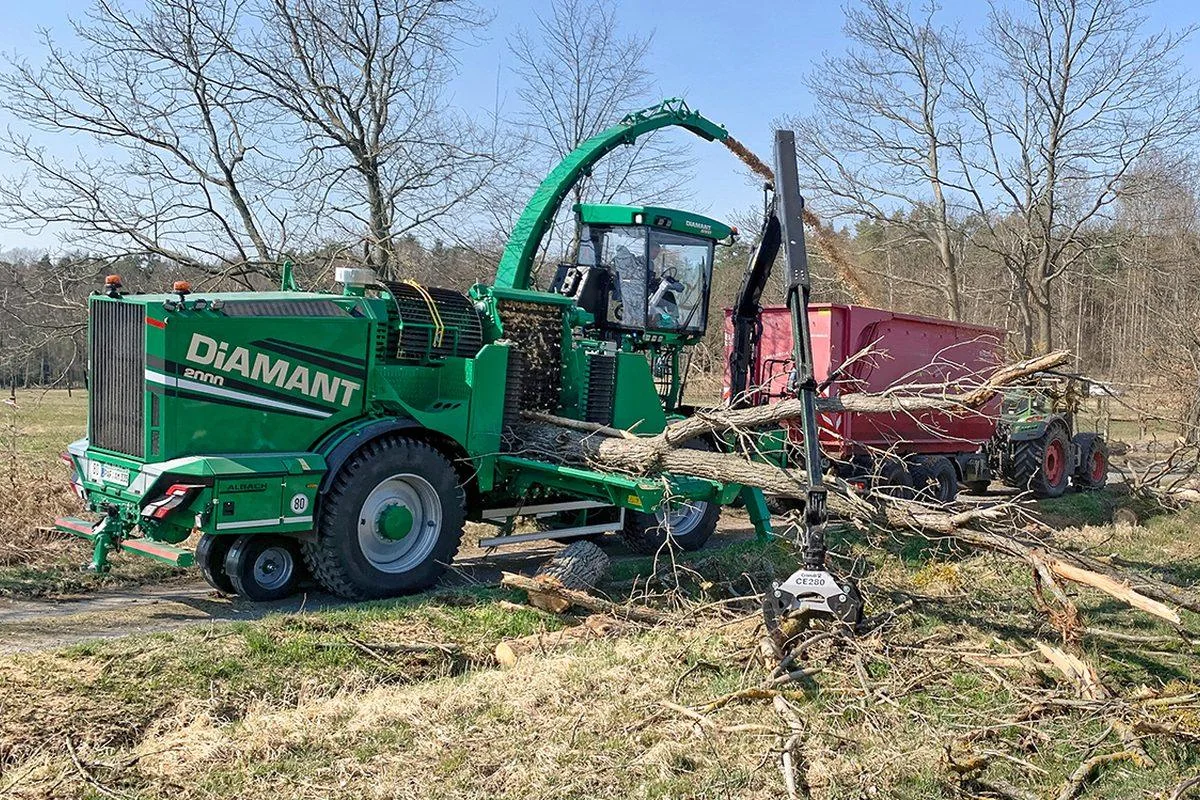
The Albach Diamant 2000 — distributed in North America by SENNEBOGEN — is a self-propelled, self-feeding whole-tree chipper. It is not a towable chipper: it is a road-legal vehicle that drives itself to the landing at up to 50 mph, feeds itself with an integrated 32 ft crane, and chips up to 17,657 cubic feet an hour on up to 795 hp. For a land clearing, biomass or large tree service operation, that combination is what turns a pile of stems into saleable chip on the same day. It finances through Axiant. Forestry financing →
All financeable through Axiant. Live inventory & pricing on SENNEBOGEN.
Up to 17,657 ft³/hSENNEBOGEN machines are manufactured by SENNEBOGEN and sold in North America through its authorized dealer network. Axiant Partners is an independent equipment finance broker — we are not a SENNEBOGEN dealer and are not affiliated with SENNEBOGEN. We arrange the financing for the buyer; machine pricing, configuration and availability come from SENNEBOGEN and its dealers. Specifications shown are from SENNEBOGEN North America and are for reference only — confirm every figure with the dealer before you buy. Financing is subject to credit approval.
| Model | Chipping Capacity | Machine | Specs |
|---|---|---|---|
| Diamant 2000 | Up to 17,657 ft³/h | Up to 795 hp · 4 ft 0 in × 3 ft 3 in feed opening · integrated crane, 32 ft 10 in reach at 2,205 lb · 270° swivelling tower · road-legal, up to 50 mph | Specs ↗ |
Most operations start with a towable chipper behind a truck, and for residential tree work that is the right machine. At the scale where you are clearing land, running biomass, or processing whole stems instead of brush, the towable model stops working — not because it cannot chip, but because of everything around the chipping:
The trade is the purchase price, which is in a different league from a tow-behind. That is a financing question, not a reason to stay small.
This is the only question that matters, and it is answerable with your own numbers rather than ours. Work out what you currently produce in a day with the chipper and loader you run now, what that material sells for or saves you in disposal, and what your crew costs to stand around while the chipper catches up. Then price the same day at Diamant throughput with one fewer machine and one fewer operator in the loop. If the gap covers the monthly payment, the machine pays for itself; if it does not, it is too early — and we would rather tell you that than write the deal. Bring the dealer quote and we will price the payment so you can run the comparison honestly.
It is easy to read the spec sheet as one very expensive chipper. It is more useful to read it as a crew:
Priced against a chipper alone it looks expensive. Priced against a chipper plus a loader plus a truck plus the second operator — and against the days you currently lose moving all of that between landings — the comparison changes shape.
Throughput only pays if the chip is saleable. The Diamant is set up to produce consistent, graded chip rather than the ragged mixed output a small tow-behind gives you on whole stems, and consistency is what separates biomass and wood-fuel buyers — who pay for a spec — from landscape-mulch buyers, who pay much less. Screen size and blade condition are the levers, and the touchscreen control lets an operator hold a profile across a shift rather than drifting. If your plan is to sell into fuel contracts rather than give the chip away to get rid of it, the machine that produces to spec is the one that turns a disposal cost into a revenue line. That flip — from paying to dump to being paid to deliver — is usually the number that justifies the purchase, so work it out before you sign anything.
A chipper that is its own vehicle. Instead of being towed to the landing and fed by a separate loader, it drives itself there on public roads, feeds itself with an integrated crane, and chips whole stems — so one machine and one operator replace a chipper, a loader and an extra hand.
Up to 17,657 ft³/h (500 m³/h), driven by up to 795 hp, through a feed opening of 4 ft 0 in wide by 3 ft 3 in high. Its integrated crane reaches 32 ft 10 in and handles 2,205 lb at full reach. Confirm final specifications with SENNEBOGEN.
Land-clearing contractors, biomass and wood-fuel producers, large-scale tree services and utility right-of-way crews — operations where the chipper is the bottleneck rather than the accessory, and where material volume is high enough that throughput is the constraint on revenue.
Yes. It finances as an equipment purchase — asset-based, with terms structured to the life of the machine, so the payment sits against the tonnage it processes. New and used both finance, and approvals commonly come back in about 24 hours.
Get the quote from SENNEBOGEN and let Axiant price the payment — then check it against the throughput the machine actually adds. If the math works, we can fund it in about 24 hours.
Most operations start with a towable chipper behind a truck, and for residential tree work that is the right machine. At the scale where you are clearing land, running biomass, or processing whole stems instead of brush, the towable model stops working — not because it cannot chip, but because of everything around the chipping:
The trade is the purchase price, which is in a different league from a tow-behind. That is a financing question, not a reason to stay small.
This is the only question that matters, and it is answerable with your own numbers rather than ours. Work out what you currently produce in a day with the chipper and loader you run now, what that material sells for or saves you in disposal, and what your crew costs to stand around while the chipper catches up. Then price the same day at Diamant throughput with one fewer machine and one fewer operator in the loop. If the gap covers the monthly payment, the machine pays for itself; if it does not, it is too early — and we would rather tell you that than write the deal. Bring the dealer quote and we will price the payment so you can run the comparison honestly.
It is easy to read the spec sheet as one very expensive chipper. It is more useful to read it as a crew:
Priced against a chipper alone it looks expensive. Priced against a chipper plus a loader plus a truck plus the second operator — and against the days you currently lose moving all of that between landings — the comparison changes shape.
Throughput only pays if the chip is saleable. The Diamant is set up to produce consistent, graded chip rather than the ragged mixed output a small tow-behind gives you on whole stems, and consistency is what separates biomass and wood-fuel buyers — who pay for a spec — from landscape-mulch buyers, who pay much less. Screen size and blade condition are the levers, and the touchscreen control lets an operator hold a profile across a shift rather than drifting. If your plan is to sell into fuel contracts rather than give the chip away to get rid of it, the machine that produces to spec is the one that turns a disposal cost into a revenue line. That flip — from paying to dump to being paid to deliver — is usually the number that justifies the purchase, so work it out before you sign anything.
A chipper that is its own vehicle. Instead of being towed to the landing and fed by a separate loader, it drives itself there on public roads, feeds itself with an integrated crane, and chips whole stems — so one machine and one operator replace a chipper, a loader and an extra hand.
Up to 17,657 ft³/h (500 m³/h), driven by up to 795 hp, through a feed opening of 4 ft 0 in wide by 3 ft 3 in high. Its integrated crane reaches 32 ft 10 in and handles 2,205 lb at full reach. Confirm final specifications with SENNEBOGEN.
Land-clearing contractors, biomass and wood-fuel producers, large-scale tree services and utility right-of-way crews — operations where the chipper is the bottleneck rather than the accessory, and where material volume is high enough that throughput is the constraint on revenue.
Yes. It finances as an equipment purchase — asset-based, with terms structured to the life of the machine, so the payment sits against the tonnage it processes. New and used both finance, and approvals commonly come back in about 24 hours.