
Updated August 1, 2026
Quick answer
Pick SBA 7(a) for flexibility — working capital, equipment, acquisitions, debt refinance, partner buyouts, or real estate up to $5 million with terms to 25 years. Pick SBA 504 for fixed-asset purchases — owner-occupied real estate or major equipment — using a structured 50% bank / 40% SBA / 10% borrower stack with long-term fixed rates and 20-25 year terms. 504 totals can reach $5M-$10M+, but it cannot fund working capital. Use 7(a) when needs are mixed; use 504 to lock long-term real estate at the lowest down payment.
What Is an SBA 7(a) Loan?
The SBA 7(a) loan is the most flexible and widely used SBA financing option.
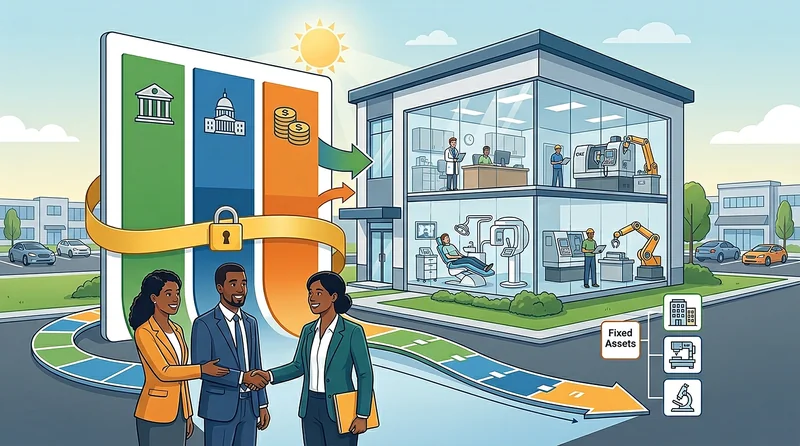
Uses:
- Working capital
- Equipment purchases
- Business acquisition
- Debt refinancing
- Partner payouts
- Commercial real estate
Key Features of SBA 7(a):
- Loan amounts up to $5 million
- Terms up to 25 years (real estate)
- Variable or fixed rate options
- Government guarantee to lender
Its flexibility makes it a common choice for operating capital and expansion. Explore SBA loan programs to find the right fit.
What Is an SBA 504 Loan?
The SBA 504 loan is designed primarily for fixed asset purchases.
Commonly used for:
- Owner-occupied commercial real estate
- Major equipment acquisitions
- Expansion facilities
Unique Structure:
- 50% bank first loan
- 40% SBA backed second lien
- 10% borrower equity injection
Key Features of SBA 504:
- Long-term fixed rates
- 20-25 year terms
- Lower down payment than conventional commercial mortgages
- Designed for real estate and fixed assets
504 loans are not typically used for working capital.
SBA 7(a) vs SBA 504: Key Differences
| Criteria | SBA 7(a) | SBA 504 |
|---|---|---|
| Use of Funds | Working capital, acquisitions, equipment | Real estate & heavy equipment |
| Loan Amounts | Up to $5 million | $5M to $10M+ |
| Terms | Up to 25 years | Typically 20 years |
| Interest Rates | Variable or fixed | Long-term fixed |
| Best For | Business capital, flexibility | Property purchases, fixed assets |
Example: 7(a) vs 504 for Real Estate
A manufacturing company needs to purchase a $2 million owner-occupied building. With SBA 504, the structure might be: $1 million bank first (50%), $800,000 SBA 504 second (40%), $200,000 borrower equity (10%). The 504 portion carries a long-term fixed rate, often lower than 7(a) variable rates for real estate. With SBA 7(a), a single loan of $1.8 million (90% LTV) with $200,000 down could work, but terms and rates differ. For pure real estate purchases, 504 is often preferred due to its fixed-rate structure and 10% down. For mixed-use (real estate plus working capital), 7(a) offers flexibility. See down payment requirements for details.
Estimate Your Payment: 7(a) vs 504
Enter a project amount and term to compare an illustrative monthly payment under each program. SBA 504 typically carries a lower blended rate (the CDC portion is long-term fixed), while 7(a) is usually a variable rate tied to Prime. These use illustrative APR ranges, not quotes — your actual rate depends on credit, the deal, and current benchmarks.
Illustrative estimate only (7a ~10.5–11.5%, 504 blended ~6.5–7.5%) — excludes fees. Not a quote or offer of credit.
See real SBA 7(a) & 504 offers — get matchedChecking options won’t affect your credit · no obligation · SBA timelines reward starting early.
The Decision Tree: Which One Fits Your Deal
Walk these questions in order and most deals answer themselves:
- Buying owner-occupied commercial real estate? 504 is the default — cheapest rate, longest term, and a fixed rate on the debenture portion.
- Buying major equipment (10+ year useful life) on its own? 504 allows it, but most buyers still use 7(a) or conventional equipment financing because a 45–75 day timeline is too slow for most equipment purchases.
- Need working capital, inventory, or a debt refinance? 7(a). 504 covers none of those.
- Buying an existing business? 7(a) for the going concern — goodwill, equipment, working capital. If real estate is part of the deal, layer 504 on top of it.
- Mixed use — real estate plus equipment plus working capital plus goodwill? Either 7(a) for everything, or 504 on the real estate and 7(a) on the rest.
Using 504 and 7(a) Together
For buying a business and its building at the same time, running both programs is usually the cheapest structure available:
- 504 finances the building. 10% down, a 50% bank first, a 40% SBA debenture, 25-year amortization at roughly 6% blended.
- 7(a) finances the going concern. Goodwill, equipment, working capital — 10–15% down, 10-year amortization at roughly 10%.
- Total buyer equity lands at 10–15% across both, materially less than conventional financing on the same deal.
- One lender, two files. The same Preferred Lender bank typically runs both in parallel and closes them within a week or two of each other.
This is the default structure for practice acquisitions — medical, dental, veterinary, accounting — along with franchise buys that include real estate and small manufacturing deals with owned buildings. See SBA loans to buy a restaurant and SBA loans for veterinary practices for how it gets structured deal by deal.
When Conventional Beats Both
SBA is not automatically the answer. Skip it when:
- You need to close in under 30 days. Even a Preferred Lender needs 30+. Bridge or conventional bank debt closes in 7–21 days.
- You are a strong sponsor with a deep balance sheet. A conventional bank may match SBA pricing without the program's resale limits and prepayment penalties.
- The deal is above $5 million. SBA caps there; anything beyond needs conventional, life-company, or CMBS debt.
- You want to avoid a personal guarantee. SBA always requires one from owners at 20%+. Some conventional lenders will go non-recourse for stronger sponsors.
Which SBA Loan Is Better?
There is no universal "better" option–it depends on your business objective.
Choose SBA 7(a) if:
- You need working capital
- You're buying a business
- You want flexibility
- You're refinancing debt
Choose SBA 504 if:
- You're purchasing commercial real estate
- You want long-term fixed rates
- You are expanding facilities
Review which structure fits your timeline and financial profile. Explore SBA loan options.
Credit & Qualification Considerations
Typical requirements for both programs include:
- Established operating history (2+ years preferred)
- Demonstrated cash flow
- Acceptable personal credit (usually 680-690+)
- Personal guarantee
- U.S.-based business
Approval timelines range from 30-60+ days depending on complexity. SBA may not be the fastest financing option available.
Rates and Fees: 7(a) vs 504
Both programs carry SBA guarantee fees. For 7(a), fees vary by loan size and term. For 504, the CDC typically charges a one-time fee (often rolled into the loan). Interest rates differ: 7(a) rates are set by the lender (often prime plus a spread) and may be fixed or variable. 504 rates are tied to Treasury benchmarks and are typically fixed for the life of the loan–attractive for borrowers who want payment certainty. Compare total cost (rate plus fees) when evaluating programs. Your lender or CDC can provide a side-by-side quote.
When SBA May Not Be Ideal
SBA loans are typically not designed for:
- Short-term bridge financing
- Speculative real estate investment
- Fix and flip projects
- Emergency capital needs
For faster access to capital, a business line of credit may be more appropriate.
Final Thoughts
Both SBA 7(a) and 504 loans provide long-term, government-backed financing for established businesses. The right option depends on whether your primary need is operational flexibility (7a) or fixed asset acquisition (504). SBA underwriting is detailed and documentation-heavy-aligning with the correct program matters. If you're exploring long-term capital and meet baseline qualifications, review available SBA loan programs.
Sources & Further Reading
- SBA 7(a) Loan Program — Official terms, eligibility and the $5 million program maximum for the SBA's primary business loan.
- SBA 504 Loan Program — Official 504 program terms: a bank, a Certified Development Company and the borrower's own injection.
- Federal Reserve Senior Loan Officer Opinion Survey — Quarterly survey of bank lending standards, including commercial real estate and business loans.
Rate, fee, and policy figures cited above reflect current published guidance as of the article publication date. Always confirm current figures with the cited source or your lender before acting on financing decisions.
Frequently Asked Questions
What is the difference between an SBA 7(a) and 504 loan?
SBA 7(a) is flexible: working capital, equipment, acquisitions, debt refinance, partner buyouts, or real estate up to $5 million with terms to 25 years. SBA 504 funds fixed assets such as owner-occupied real estate or major equipment using a 50% bank, 40% SBA, 10% borrower structure, and cannot fund working capital.
Which SBA loan is better for real estate?
SBA 504 is usually better for owner-occupied real estate because it offers long-term fixed rates, 20-25 year terms, and the lowest down payment. Use 7(a) when needs are mixed.
How much can you borrow with SBA 7(a) vs 504?
SBA 7(a) goes up to $5 million. SBA 504 totals can reach $5M-$10M+ across the bank and CDC portions combined.
Can the SBA 504 loan fund working capital?
No. The 504 program is for fixed assets only. If you need working capital or mixed uses, the 7(a) is the right program.
Is SBA 504 or 7(a) better?
It depends on the use of funds. Compared head to head — SBA 504 vs 7(a) — the 504 is the fixed-asset specialist: for owner-occupied real estate or a single large piece of equipment it usually wins on rate, term, and down payment. The 7(a) is the all-purpose program: for anything mixed — working capital, an acquisition, debt refinance, or real estate combined with other needs — 7(a) is the more flexible choice. Many borrowers who search “504 vs 7a” are really asking which fits a specific project, so start from the use of funds, not the program name.